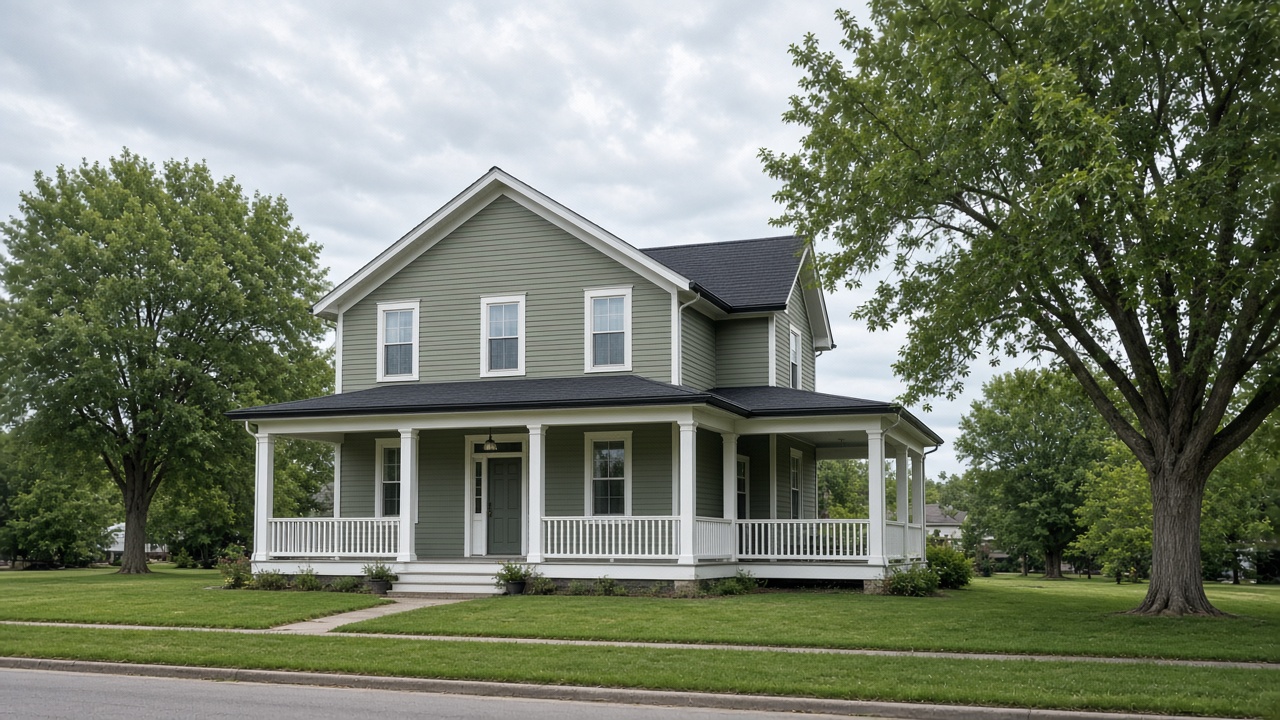
We paint the exteriors of historic and older homes in Leavenworth, KS with the gentlest prep that will hold a new coat, and if your house is register-listed or in a historic district, the first step is a conversation with city planning staff. This page sets out what the city and state pages say about review, how old paint is judged, and the rules that come with older houses.
How old Leavenworth's houses are
Leavenworth calls itself the first city of Kansas, founded in 1854, and its housing shows that history. In Census Bureau survey estimates, 4,131 of the city's 14,864 homes, more than a quarter, were built in 1939 or earlier, and about six in ten were built before 1980.
The city's district descriptions mention weatherboard and clapboard siding, wood shingles on upper stories, painted brick, porches and bracketed cornices. Porches, brackets and cornices take more care to prepare and paint than a plain wall, and older houses tend to carry more layers of old paint. See wood siding painting and trim, fascia and soffit painting for the details of each.
Leavenworth's historic districts
These are the city's neighborhood historic districts, with their register listings from the Kansas Historical Society and a line from the city's own description of each:
| District | Register listing | What the city's page says |
|---|---|---|
| North Esplanade | National Register, December 12, 1977 | The city's first historic district: fourteen residences and North Esplanade Park along four blocks, with larger structures built from the 1860s through the 1880s |
| Arch Street | National Register, July 3, 2002 | 10 acres in an addition platted in 1857, where the earliest homes are Italianate and date to the late 1860s and 1870s |
| North Broadway | National Register, July 3, 2002 | A compact district of seven acres with 39 contributing structures |
| South Esplanade | National Register, July 3, 2002 | An 1857 addition to the city, where one house started out as a simple, clapboard-covered frame house |
| Third Avenue | National Register, July 3, 2002 | Platted in 1856, with houses built between 1859 and 1920 of brick or weatherboard siding |
| Union Park | National Register, July 3, 2002 | About six acres just south of the central business district, with styles from Italianate and Second Empire to Queen Anne, Craftsman and Colonial Revival |
The state's register search also lists the Leavenworth Downtown, Leavenworth Historic Industrial and Leavenworth Landing districts, and shows 51 listings in all for Leavenworth County. To check your own address, start with the city's districts page and the Kansas Historical Society's register search.
Do you need approval to repaint a listed house?
Here is what the city and state pages say, and what they leave open:
- No building permit for painting. The City of Leavenworth lists painting among the finish work that needs no building permit.
- Changes to listed properties need review. The city's historic preservation page says any proposed change to a property on the National or State Register, within a registered historic district, or designated a local landmark requires a state law review, a Certificate of Appropriateness or both, as required by the Kansas State Preservation Statute (K.S.A. 75-2724). It asks owners to contact staff to discuss proposed work and determine the level of review.
- Permits trigger state review. The Kansas Historical Society says all projects that need permits from a state or local government will be reviewed, and that for a register-listed property, the permit application itself triggers that review.
- Repainting alone is not settled. None of the city or state pages we read says whether repainting alone, with no other work, needs a certificate, and the city's minor certificate form does not list painting.
So before work starts on a listed house or a house in a district, contact city planning staff. Tell them what is being painted, whether any wood is being repaired or replaced, and whether the colors are changing. The answer comes from the city, not from us.
Repairs that do bring review: siding, windows, porches and fascia
Repairs that need a permit bring review on a listed property. A siding change-out needs a city permit and an inspection of the final installation, and every window or door change-out needs a permit and a framing inspection, even at like-for-like sizes. The Kansas Historical Society says the local government must get a letter from the State Historic Preservation Office before it issues permits for projects on register-listed properties.
Smaller repairs have a form of their own. The city's Minor Certificate of Appropriateness application lists project types that include like-kind repair of architectural elements such as porches, fascia, windows and doors, like-kind replacement of roofing, and minor exterior building changes. It asks for a letter of intent and a notarized owner signature. If your quote finds decayed porch parts or fascia, allow time for that step before the repair and the paint.
Old paint: clean, scrape or strip
The National Park Service's paint brief for historic woodwork says paint removal should be avoided unless it is absolutely essential, apart from cleaning, light scraping and hand sanding as routine maintenance. Its general approach is to remove paint to the next sound layer using the gentlest means possible, then repaint. It sorts paint condition into three classes:
| Class | What the paint shows | Treatment |
|---|---|---|
| Class I | Dirt and soot, mildew, excessive chalking, staining | Generally no paint removal: clean it |
| Class II | Crazing, intercoat peeling, solvent blistering, wrinkling | Limited removal: scrape and sand to the next sound layer |
| Class III | Peeling to bare wood, cracking and alligatoring | Generally total removal in the affected areas |
Two more points from the same brief. If the paint shows no chalking, blistering, peeling or cracking, there is no physical reason to repaint, and faded color alone is not enough reason to repaint a historic building. And before the paint is judged at all, the wood is checked for decay, because repair or replacement of deteriorated wood should take place before repainting. Our guide to preparing wood siding for paint walks through the steps.
When too many layers become the problem
Old houses can carry a century of paint, and the buildup itself can cause failure. The Park Service says that when paint reaches about 1/16 inch, roughly 16 to 30 layers, one or more extra coats may be enough to trigger cracking and peeling, and that thick paint fails at the oldest layers, next to the wood. The USDA Forest Products Laboratory adds that cross-grain cracking usually shows up on houses with thick layers of old oil-alkyd paint, and that the fix is removing the old paint in those areas.
When paint is near that thickness, the Park Service suggests that changing accent colors on limited portions of the trim might be an acceptable compromise, rather than another coat over everything. Our guide to why exterior paint peels covers how to tell buildup from water damage.
Methods that stay away from old woodwork
The Park Service does not recommend blow torches on old woodwork, noting that buildings have been set on fire with them and that lead-base paints vaporize at high temperatures. It also advises against sandblasting, rotary sanding discs, rotary wire strippers, and water blasting above 600 psi, which can force water into the wood.
EPA's lead rule separately prohibits three practices on covered work: open flame burning or torching; sanding, grinding, planing, needle gunning or blasting with power tools that lack a shroud and HEPA vacuum attachment; and heat guns at temperatures greater than 1100°F. On an older Leavenworth house, both lists apply.
Choosing colors for an older house
The Park Service treats color as beyond the scope of its paint brief. It says only that new colors should, at a minimum, be appropriate to the style and setting of the building. For an Italianate house on Arch Street or a Queen Anne in Union Park, that means starting from the style of the house and the street it stands on. The city pages we read publish no color list, and none says whether a color change on a listed house needs review, so ask planning staff before you choose. We do not claim any color approval for any house.
Kansas tax credit for listed houses: ask before work starts
Starting July 1, 2025, eligible projects in Kansas communities with populations under 50,000 receive state historic tax credits equal to 40% of qualifying project costs, according to the Kansas Historical Society. Leavenworth's population is 37,195 in the Census Bureau's 2024 five-year estimates. The rules that matter most for a paint job:
- Qualified expenses must be paid by the building owner and must total $5,000 or more.
- The property must be listed on the state or National Register before an application for credits is submitted. For a building in a listed district, a one-page form is reviewed to confirm the building contributes to the character of the district.
- The application must be submitted and approved before physical work begins, and all work must meet the Secretary of the Interior's Standards for Rehabilitation.
The society's list of example qualified expenditures includes exterior building surfaces and painting on structural surfaces. The same list says it is not absolute and that every case is reviewed on its own merit. The State Historic Preservation Office decides what qualifies, and a tax professional should check your own case before you count on any credit.
Lead paint on houses built before 1950
The Park Service's brief assumes that houses built before 1950 involve one or more layers of lead-base paint, and EPA's national chart puts 87% of homes built before 1940 as likely to have lead-based paint. Paid prep that scrapes or sands that paint falls under the lead rule, which Kansas runs through its own program. Our lead paint guide explains what the rule requires on the outside of an older house.
Historic home painting questions
Is my house in a Leavenworth historic district?
Check two places: the city's historic districts page, which describes each district, and the Kansas Historical Society's register search for Leavenworth County, which lists districts and individual properties with their listing dates. If you are still unsure, ask city planning staff.
Do I need a permit or a certificate to repaint a historic house in Leavenworth?
No building permit. The city lists painting among the finish work that needs none. For a listed house or one in a historic district, the city says proposed changes need review and asks owners to contact staff to learn the level, and the pages we read do not settle whether repainting alone needs a certificate, so ask before work starts.
Should old paint be stripped to bare wood?
Only where it has failed to the wood. The Park Service generally calls for total removal in areas peeled to bare wood, cracked or alligatored, and for cleaning or scraping to the next sound layer everywhere else.
Can exterior painting count toward the Kansas historic tax credit?
It can, under conditions. Painting on structural surfaces is on the Kansas Historical Society's example list of qualified expenditures, but the property must already be listed, the qualified expenses must reach $5,000 and the application must be approved before work begins. Each case is reviewed on its own merit.
Sources
- City of Leavenworth, Frequently Asked Questions: Inspections, read November 26, 2026
- City of Leavenworth, Roofing, Windows and Siding, read November 26, 2026
- City of Leavenworth, Historic Preservation, read November 26, 2026
- City of Leavenworth, Historic Districts and Neighborhoods, with the district pages for North Esplanade, Arch Street, North Broadway, South Esplanade, Third Avenue and Union Park, read November 26, 2026
- City of Leavenworth, Minor Certificate of Appropriateness application, September 2019, read November 26, 2026
- U.S. Census Bureau, American Community Survey 2024 5-year estimates (2020 to 2024), via Census Reporter: Year Structure Built, Leavenworth and Lansing, KS and the Leavenworth, KS profile, read November 26, 2026
- Kansas Historical Society, National and State Registers listings, Leavenworth County, read November 26, 2026
- Kansas Historical Society, State Historic Tax Credit, read November 26, 2026
- Kansas Historical Society, Examples of Qualifying and Non-Qualifying Expenditures, updated September 7, 2017, read November 26, 2026
- Kansas Historical Society, State preservation law, read November 26, 2026
- National Park Service, Preservation Brief 10: Exterior Paint Problems on Historic Woodwork, September 1982, read November 26, 2026
- USDA Forest Service, Forest Products Laboratory, Wood Handbook, Chapter 16: Finishing Wood, General Technical Report FPL-GTR-282, 2021, read November 26, 2026
- U.S. Environmental Protection Agency, The Lead-Safe Certified Guide to Renovate Right, revised September 2011, read November 26, 2026
- U.S. Environmental Protection Agency, Reduce the Risk of Lead Exposure at Home, read November 26, 2026
Get a quote for an older home
We paint older homes across Leavenworth and in Lansing; the service area page has the details, and our exterior painting cost page explains why older houses take more prep. Send a photo of each side, close photos of the worst paint and any soft wood, and tell us whether the house is listed or in a historic district. Get a Quote