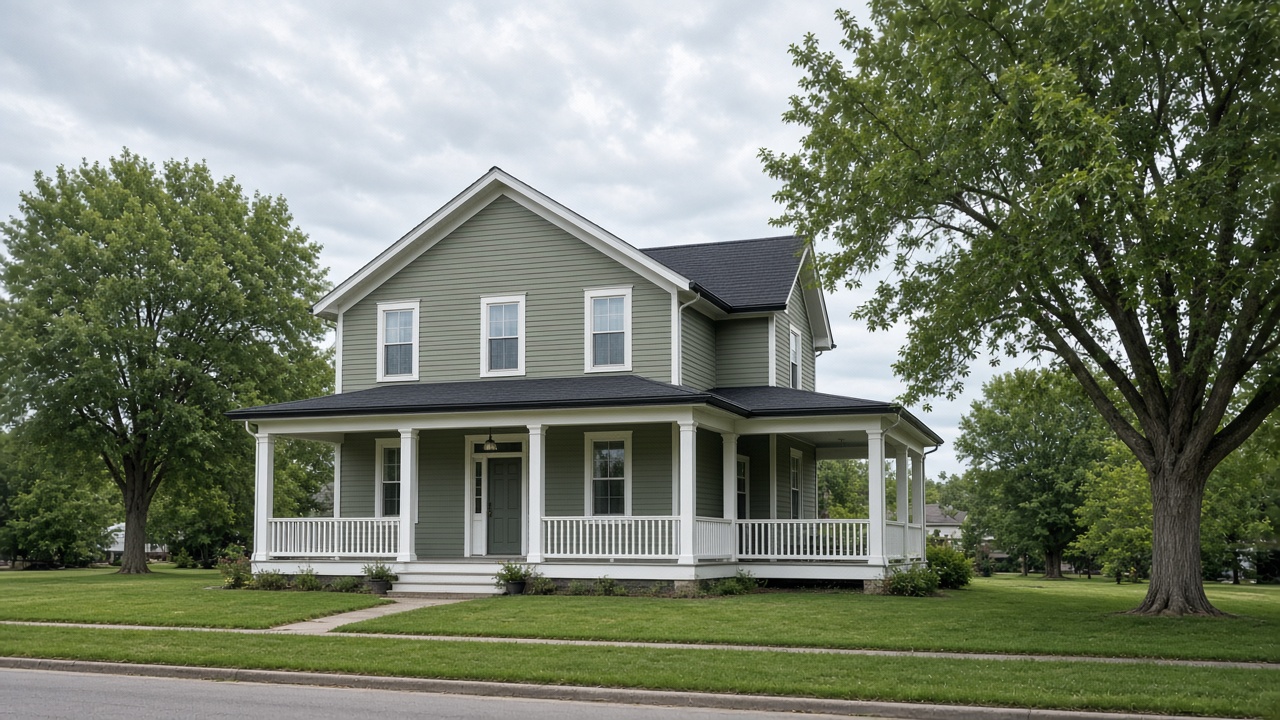
We paint exterior trim, fascia and soffits in Leavenworth, KS, on their own or along with the siding, and these are the boards where paint fails first because water sits on flat surfaces and soaks into end grain. A trim repaint that lasts starts with finding where the water gets in.
Which boards count as trim, fascia and soffit
- Window and door trim: the casings around the openings and the sills below the windows.
- Corner boards: the vertical boards at the outside corners of the walls.
- Fascia: the board along the roof edge that the gutter usually hangs on.
- Soffits: the underside of the eaves, between the fascia and the wall.
- Porch parts: posts, rails and balusters, the porch ceiling, and on older houses the brackets and cornices.
If the walls need paint too, see wood siding painting. How much trim a house has is one of the things that moves the price of a paint job, and our exterior painting cost page explains the others.
Why paint fails first on trim
Three things work against paint on trim.
- Flat surfaces. The National Park Service notes that horizontal surfaces such as window sills deteriorate faster than the rest of the house and will need repainting more often.
- End grain. Trim is full of board ends, and the USDA Forest Products Laboratory says liquid water enters wood 10 to 100 times faster through end grain than through the other faces. It finds water blisters common near unsealed end grain of siding and trim.
- Finger-jointed lumber. Finger-jointed lumber is commonly used for fascia boards and exterior trim, and the laboratory notes that paint on it often fails in a patchwork pattern at the joints.
Our guide to why exterior paint peels explains how to read each kind of failure.
Fascia and gutters: stop the water before painting
Leaking gutters and faulty flashing are on the Park Service's list of moisture problems to correct before repainting, along with defective roof shingles, cracks and holes in siding and trim, deteriorated caulking and shrubbery growing too close to painted wood. The Forest Products Laboratory adds that ice dams and overflow from blocked gutters cause water blisters. A fascia board under a leaking gutter will keep peeling however carefully it is painted. When your photos show a gutter or flashing problem above the trim, we point it out in the quote so it can be dealt with before the paint goes on.
Soffits and porch ceilings: washing matters more than scraping
Soffits, porch ceilings and walls under overhangs are protected from the rain, and that is their problem. The Forest Products Laboratory says these protected areas collect dirt that weakens the grip of new paint, so they need cleaning before they are painted. The Park Service says peeling between coats most often happens in protected areas such as eaves and covered porches, because rain never rinses them.
Mildew is the other issue. Dew forms on parts of a house that cool quickly, such as eaves, soffits and porch ceilings, and mildew is most common where moisture stays longest. A drop of household bleach tells mildew from dirt: mildew turns white, and dirt stays dirt.
These areas also need paint less often than the walls. The laboratory says repainting protected areas every other time the house is painted usually gives adequate performance.
Caulk: where it helps and where it traps water
Open joints and cracks in trim are caulked before painting, and deteriorated caulking in joints and seams is one of the moisture sources the Park Service lists. But caulk has limits. The Forest Products Laboratory says sealants are not a substitute for flashing and good design, and that a failed sealant often traps water and makes things worse. One joint stays open on purpose: the horizontal overlap of lap siding, which lets water run out and air move behind the boards to dry them. The same scrape, wash and prime order in our wood siding prep guide applies to wood trim.
Rot repair before paint, and when the city wants to know
Paint over decayed wood does not last, and the Park Service puts repair or replacement of deteriorated wood before repainting. When we find soft boards, the quote says which ones.
On a house that is listed or in a historic district, repairs can bring city review. The City of Leavenworth's Minor Certificate of Appropriateness form lists "repair of architectural elements such as porches, fascia, windows, doors, with like-kind replacement materials" as a project type, and the city asks owners to contact staff to find out the level of review. Window and door change-outs need city permits and framing inspections even at like-for-like sizes. Our page on historic home exterior painting covers the rest of the review rules.
Trim-only repaints and accent colors on older houses
On an older house, the trim may carry decades of paint. The Park Service says that when paint builds up to about 1/16 inch, roughly 16 to 30 layers, one or more extra coats may be enough to set off cracking and peeling. When paint is near that thickness, it suggests that changing accent colors on limited portions of the trim might be an acceptable compromise, rather than another full coat over everything.
Trim also runs on its own schedule. Sills and other horizontal parts need paint more often than the walls, the Forest Products Laboratory says the sides of a house do not need to be painted on the same schedule, and protected areas can often skip a cycle. That is why a trim-only repaint between full repaints can make sense.
Lead-safe prep on old trim and window sills
Doors and window sills are the friction surfaces EPA names: old or worn lead-based paint on surfaces subject to constant friction can produce chips and dust. Under EPA's rule, paid exterior work on a pre-1978 house is covered once it disturbs more than 20 square feet of paint, and that 20 square feet is counted across the whole job, not per side. Window replacement is covered at any size. Our lead paint guide explains what the rule requires and how Kansas runs it.
Trim, fascia and soffit painting questions
Can you paint only the trim and leave the siding?
Yes. Sills and other trim wear out sooner than siding, and the sides and parts of a house do not need to be painted on the same schedule. If the siding is failing too, the quote can cover both.
Why does paint peel on my window sills first?
Water. Sills are horizontal, so they deteriorate faster than walls, and their end grain soaks up water 10 to 100 times faster than the face of the board. Fix any leak around the window first, then scrape, prime and seal the ends.
Do rotted fascia boards have to be replaced before painting?
Yes, repaired or replaced. Paint over decayed wood does not last, and the Park Service puts repair or replacement of deteriorated wood before repainting. Find out why the board rotted, too, since a leaking gutter or faulty flashing can rot the new board as well.
Does repairing a porch or fascia on a historic house need city approval?
It may. The city's Minor Certificate of Appropriateness form lists like-kind repair of porches, fascia, windows and doors as a project type for listed properties, and the city asks owners to contact staff to find out what level of review applies.
Sources
- City of Leavenworth, Roofing, Windows and Siding, read November 26, 2026
- City of Leavenworth, Historic Preservation, read November 26, 2026
- City of Leavenworth, Minor Certificate of Appropriateness application, September 2019, read November 26, 2026
- National Park Service, Preservation Brief 10: Exterior Paint Problems on Historic Woodwork, September 1982, read November 26, 2026
- USDA Forest Service, Forest Products Laboratory, Wood Handbook, Chapter 16: Finishing Wood, General Technical Report FPL-GTR-282, 2021, read November 26, 2026
- USDA Forest Service, Forest Products Laboratory, Research Note FPL-0232: How to Refinish Wood Siding with Latex Paints, 1976, read November 26, 2026
- U.S. Environmental Protection Agency, Lead Renovation, Repair and Painting Program, read November 26, 2026
- U.S. Environmental Protection Agency, Renovation, Repair and Painting Program: Contractors, read November 26, 2026
- U.S. Environmental Protection Agency, Frequent Questions About Renovations Covered by the RRP Rule, read November 26, 2026
Get a trim painting quote
Send close photos of the sills, fascia and soffits that are failing, a photo of the gutters above them and one wide photo of each side of the house. Get a Quote