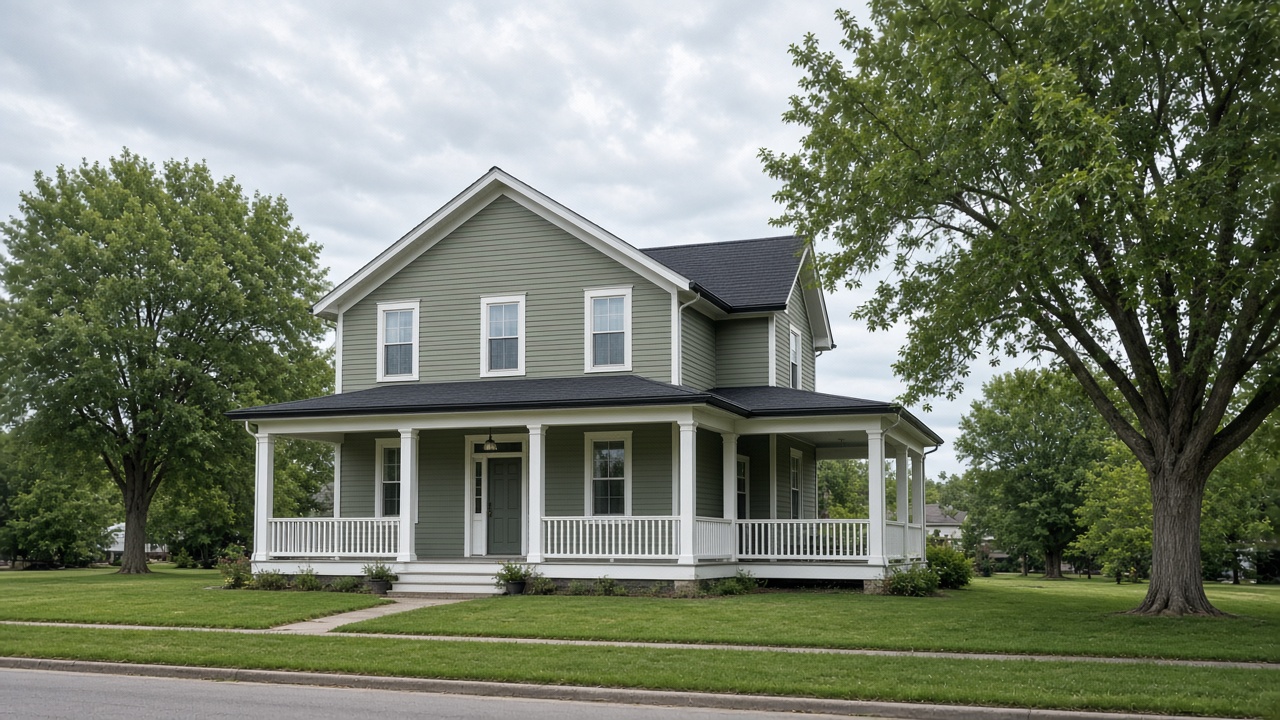
We paint wood siding in Leavenworth, KS, clapboard, weatherboard and shingles alike, and most of the job is preparation: washing, scraping loose paint and priming bare wood before the topcoats go on. On smooth wood siding, the USDA Forest Products Laboratory expects a primer and two topcoats to last about 6 to 15 years in an average U.S. location, depending on the wood, and the prep is what lets a paint job reach that.
What wood siding painting covers
Wood siding painting covers the walls and the boards that frame them: lap siding and clapboard, weatherboard, wood shingles and corner boards. The work runs in the order the Forest Products Laboratory gives for repainting wood siding:
- Scraping off loose paint.
- Sanding bare spots and feathering the edges of the old paint so the new coat lies flat.
- Washing chalk, dirt and mildew off the old paint.
- Letting the wood dry, then priming the bare spots.
- Caulking open joints and cracks, but not the horizontal laps.
- The topcoats. The quote states how many. The laboratory's longest-lasting system on smooth wood is a primer and two topcoats.
Window casings, sills, fascia and soffits wear on their own schedule and have their own page: trim, fascia and soffit painting. How much old paint has to come off is also one of the biggest things that moves the price, and our exterior painting cost page explains the rest.
Wood siding in Leavenworth's older neighborhoods
About 28% of Leavenworth's homes were built in 1939 or earlier, according to Census Bureau survey estimates. The city's own descriptions of its historic districts show the kind of siding on many of those houses. It describes the current houses in the Third Avenue district as built between 1859 and 1920, and the homes it features there as two-story, of brick or weatherboard siding, each with some type of porch. On Arch Street, it names an Italianate house with weatherboard siding, built in 1865, as thought to be the oldest in the district. Its North Esplanade page describes a clapboard house that was formerly painted white, and the district pages also mention wood shingles on upper stories.
Old weatherboard and clapboard can carry many coats of paint. The National Park Service's advice for historic woodwork is to remove paint only to the next sound layer, by the gentlest means possible, and then repaint. If your house is listed or sits in one of the city's historic districts, read our page on historic home exterior painting before you plan the work.
How we prepare wood siding for paint
Our prep follows the order in the Forest Products Laboratory's research note on refinishing wood siding with latex paint:
- Scrape off all loose paint.
- Sand the bare spots and feather the edges of the surrounding paint.
- Wash the chalk off the old paint with a sponge and a detergent solution, and rinse with a garden hose.
- Wait for 2 or 3 days of sunny, dry weather, then prime the bare spots.
- Caulk all open joints and cracks.
- Apply the topcoats as the paint maker directs.
One caution comes before step 1 on any house built before 1978. The laboratory's Wood Handbook tells anyone working on old painted surfaces to assume that one or more of the coats contain lead. Its sanding advice, 50 to 80 grit paper to remove the weathered surface and feather the paint edge, applies only in the absence of lead-based paint, and it says plainly: do not sand lead-based paint. The full walk-through, with the tape tests that show whether old paint will hold new paint, is in our guide to preparing wood siding for paint.
Why bare wood is primed within days
Sun on bare wood before painting is a major cause of paint failure, according to the Forest Products Laboratory. In its test on cedar boards finished with a primer and two latex topcoats:
- Boards left bare in the sun for 16 weeks before painting peeled and needed refinishing within 3 years.
- Boards left bare for 1 week started peeling after 13 years.
- Boards never exposed were still in good condition after 20 years.
So bare wood should be primed as soon as it is dry, not left open while the rest of the house is scraped. Siding that has already weathered to silver or gray is badly degraded at the surface, and it needs sanding back to sound wood before a paint film will stick. Primer and paint both need the right weather as well. Our guide to when to paint a house exterior in Leavenworth covers the 50°F rule, dew and hot walls.
Primer and two topcoats: how long paint lasts on wood siding
The Forest Products Laboratory's Wood Handbook gives these expected service lives for paint on wood siding, for an ideal system of one primer coat and two topcoats in an average location in the contiguous United States:
| Wood siding | Expected years of paint life |
|---|---|
| Cedar or redwood, smooth, vertical grain | 10 to 15 |
| Cedar or redwood, smooth, flat grain | 8 to 12 |
| Cedar or redwood, saw-textured | 15 to 20 |
| Pine, fir or spruce, smooth, flat grain | 6 to 10 |
| Pine, fir or spruce, saw-textured | 8 to 12 |
| Sawn shingles on side walls | 6 to 10 |
A primer and one topcoat cuts those figures to about half. The handbook adds that expected life depends on climate and exposure, and that paint on the shaded side of a house often lasts twice as long as paint on a fully exposed, sunny side. Different sides do not need to be painted on the same schedule. Where two topcoats everywhere is not practical, the handbook suggests two on the fully exposed south and west sides and one on the others.
So how often does a house in Kansas need repainting? There is no single number. It depends on the wood, its texture, the number of coats and which way each wall faces. Repainting too often is a problem of its own: the handbook says sound paint that is only discolored by mildew should be washed, not repainted, and that too many coats of latex paint can eventually lead to adhesion failure of the primer.
Brown stains on painted cedar and redwood
Brown or reddish stains on painted cedar or redwood siding are often extractives: colored substances in the heartwood of western redcedar and redwood that water carries to the paint surface, where they leave a yellow to reddish brown stain. Another coat of the same paint will not stop the problem. The Forest Products Laboratory's fix is a stain-blocking primer, then a new topcoat. Knots cause a similar problem, since the knots of almost all species contain enough oils and resins to discolor light-colored paint, and the Park Service adds rusting nail heads to the list of stain sources.
Because water drives the stain, find the water first. The Park Service says to fix the moisture problem and then use a stain-blocking primer. Stains that run down the face of the siding point to water behind it, and the handbook lists the usual sources: roof leaks, faulty gutters or ice dams, condensation from inside the house, often from bathrooms or kitchens, and wind-blown water. Our guide to why exterior paint peels covers the stains and mildew that look like paint failure.
Board ends, joints and the bottom course
Peeling and flaking are often worst at the ends of boards. Liquid water enters wood 10 to 100 times faster through end grain than through the other faces, so sealing end grain is critical, and water blisters are common near unsealed end grain of siding and trim.
Open joints and cracks get caulk. The horizontal overlap of lap siding does not: the Forest Products Laboratory says to leave that gap open so water can run out and air can move behind the siding and dry it. It also warns that caulk is not a substitute for flashing and good design, and that a failed bead often traps water and makes things worse.
The bottom course sits closest to the ground and to plantings. The Park Service lists shrubbery growing too close to painted wood among the moisture sources to correct before repainting, along with faulty flashing, leaking gutters and deteriorated caulking.
When boards have to be replaced before paint
Paint over decayed wood does not last. The Park Service says to check that the wood has not decayed before judging the paint, and that repair or replacement of deteriorated wood should take place before repainting. When we find soft or split boards, the quote says which ones. In Leavenworth, a siding change-out needs a city permit and an inspection of the final installation, so replacing siding is a separate step with its own paperwork.
Lead-safe prep on wood siding painted before 1978
On a house built before 1978, paid prep that scrapes or sands old paint falls under EPA's lead renovation rule, which Kansas runs through its own state program, while painting with no prep that disturbs the old paint does not. Our lead paint guide explains the 20 square foot line, containment and what to ask any painter.
Wood siding painting questions
Does all the old paint have to come off?
No. Only areas that have peeled to bare wood or cracked and alligatored call for full removal. Dirt, chalk and mildew are cleaned off, and crazing or peeling between coats is scraped and sanded back to the next sound layer, following the Park Service's three classes of paint condition.
Should wood siding be pressure washed before painting?
Usually not at high pressure. The Park Service advises against water blasting above 600 psi on old woodwork because it can force water into the wood, and it calls a detergent solution, a medium soft bristle brush and a garden hose the gentlest method. The Forest Products Laboratory adds that if high pressure is needed to get paint off, the paint probably did not need to come off.
How long does washed siding need to dry before primer?
Two or three days of sunny, dry weather before primer goes on the bare spots, according to the Forest Products Laboratory's research note on repainting wood siding. Painting wet wood raises the risk of blistering and peeling.
Can gray, weathered siding be painted?
Yes, after sanding back to sound wood. Gray or silver wood is badly degraded by the sun, and paint peels from it unless the weathered layer comes off first. A strip of strong tape pressed on and snapped off is the test: if wood fibers come away with it, paint will peel there.
How often does a house need repainting in Kansas?
About every 6 to 15 years for smooth wood siding with a primer and two topcoats, by the Forest Products Laboratory's estimates for an average U.S. location, and 15 to 20 for saw-textured cedar or redwood. The sunny south and west sides go first, and a shaded side often lasts twice as long. One topcoat cuts those figures about in half.
Sources
- City of Leavenworth, Roofing, Windows and Siding, read November 26, 2026
- City of Leavenworth, Historic Districts and Neighborhoods, with the Third Avenue, Arch Street and North Esplanade district pages, read November 26, 2026
- U.S. Census Bureau, American Community Survey 2024 5-year estimates (2020 to 2024), via Census Reporter: Year Structure Built, Leavenworth and Lansing, KS, read November 26, 2026
- National Park Service, Preservation Brief 10: Exterior Paint Problems on Historic Woodwork, September 1982, read November 26, 2026
- USDA Forest Service, Forest Products Laboratory, Wood Handbook, Chapter 16: Finishing Wood, General Technical Report FPL-GTR-282, 2021, read November 26, 2026
- USDA Forest Service, Forest Products Laboratory, Research Note FPL-0232: How to Refinish Wood Siding with Latex Paints, 1976, read November 26, 2026
- U.S. Environmental Protection Agency, Lead Renovation, Repair and Painting Program, read November 26, 2026
- U.S. Environmental Protection Agency, Frequent Questions About Renovations Covered by the RRP Rule, read November 26, 2026
Get a wood siding painting quote
Send a photo of each side of the house, close photos of the worst boards and paint, and about when the house was built. Get a Quote